What Is Takt Time? Aligning Production with Demand



.webp)
published
July 2, 2026
Key Takeaways
Takt time sets your production pace to match customer demand, calculated as net available time divided by customer demand.
It differs from cycle time (actual task duration) and lead time (total order fulfillment time). Comparing the three reveals bottlenecks and overproduction.
Takt time works best in stable-demand environments; volatile demand or highly customized production require more flexible approaches.
Manual time studies and andon boards are the traditional way to track takt time, but connected workforce platforms can automate this tracking in real time.
Implementing takt time well requires frontline input, not just a top-down mathematical target, to avoid burnout and quality issues.
What Is Takt Time?
Takt time means setting your entire production line's pace to the exact tempo of customer demand. Instead of building products as fast as possible, takt time calculates the precise rate you must complete a product to satisfy customer orders.
Its name comes from the German word "takt," which means pulse, beat, or musical rhythm. The takt time concept traces back to 1930s German aviation design; later the Toyota Production System (TPS) adopted and refined the framework, transforming it into a cornerstone of Lean manufacturing.
In practice, takt time acts as the ultimate metronome for your manufacturing or development line. By dividing your total available production time by the number of units customers demand, you establish a steady, mathematical rhythm for your operations. If your metronome clicks every 10 minutes, every station on the line must synchronize its tasks to finish a unit within that exact window.
Operating faster than this cadence creates wasteful overproduction, while falling behind triggers delays and shortages. Ultimately, takt time aligns your internal processes with the external speed of the market, ensuring you build what the customer needs when they need it.
{{callout1}}
Takt Time vs. Cycle Time vs. Lead Time
While takt time dictates the rate you should work to meet customer demand, cycle time and lead time measure how fast you actually perform. Cycle time quantifies the precise duration it takes an operator or machine to complete a single unit from start to finish. Lead time expands that window entirely, tracking the end-to-end journey from the exact moment a customer places an order to final delivery.
In short, takt time is the external target set by the market, cycle time is the internal speed of a single station, and lead time is the total duration your customer waits to receive the finished product.
Discrepancies between these metrics immediately reveal operational bottlenecks or hidden waste. When your cycle time runs faster than your takt time, your line produces items quicker than customers buy them, which triggers overproduction and chokes your warehouse with excess inventory. Conversely, when your cycle time is slower than your takt time, your operations lag behind the market's heartbeat, forcing your customers to endure long wait times and missed deadlines.
Lean operators constantly tune their processes to match cycle time to takt time, balancing the entire system to achieve a smooth, uninterrupted flow.
How To Calculate Takt Time: Formula & Variables
Calculating takt time is a simple mathematical formula that directly links your operational availability to your customers' desires. The standard equation divides your total available production time by your customer demand within a specific period:
Takt Time = (Net Available Time/Customer Demand)
To achieve a precise calculation, you must break down each variable carefully:
- Determine gross time: Identify the total time your team or facility operates during a shift or day. For example, a standard 8-hour shift equals 480 gross minutes.
- Calculate net available time: Subtract all planned, non-productive time from your gross time. You must exclude breaks, lunches, team meetings, scheduled maintenance, clean-up periods, or any other time when no production occurs. If your 8-hour shift includes two 15-minute breaks and a 30-minute lunch, you subtract 60 minutes, leaving a net available time of 420 minutes.
- Define customer demand: Total the exact number of product units your customers require within that same time frame. If your buyers order 210 units per day, your daily demand variable is 210.
- Do the math: Divide your net available time by your customer demand to find your required pace. Using the numbers above, 420 minutes divided by 210 units yields a takt time of exactly 2 minutes per unit. Your team must produce one finished item every 2 minutes to stay perfectly synchronized with the market.
When you compare your actual cycle time against your target takt time, the results dictate your operational efficiency:
- Cycle time < Takt time (too fast): Your line produces items quicker than customers buy them. This mismatch triggers overproduction, creates excess inventory, and chokes your warehouse with expensive, stagnant goods.
- Cycle time > Takt time (too slow): Your operations lag behind the market's tempo. This delay forces your customers to endure long wait times, stretches your overall lead time, and results in missed deadlines or lost revenue.
Why Does Takt Time Matter? The Strategic Benefits
Implementing takt time strips waste from your workflow by eliminating overproduction, the most damaging of the eight classic wastes of Lean manufacturing. By locking your production speed directly to the pulse of customer demand, your team builds only what the market requires.
This naturally stabilizes inventory levels and prevents costly surpluses from clogging your warehouse. This steady rhythm instantly exposes bottlenecks in your assembly lines. Because every station must complete its tasks within the identical takt window, any delay is immediately visible, so managers can reallocate resources and balance the line before work-in-progress inventory piles up.
This predictable cadence fundamentally improves workforce management and employee morale. Instead of forcing teams to endure stressful, erratic cycles of frantic rushing followed by idle downtime, takt time establishes a transparent, achievable daily target. Managers can schedule labor with precision because they know exactly how many workers they need to sustain the right speed. This predictability reduces burnout, eliminates chaotic overtime, and empowers frontline employees to take ownership of a clear, structured pace, transforming a stressful environment into a calm, continuous flow.
{{callout2}}
Takt Time Limitations and Pitfalls
While takt time is a powerful framework for stable environments, rapid and unpredictable fluctuations in customer demand can shatter rigid production models. Calculating a steady pace is nearly impossible when order volumes spike or plummet wildly overnight.
If a manager recalculates and shrinks the takt time abruptly to chase a sudden spike, the line descends into chaos; if they stretch it too wide during a dip, workers sit idle. Similarly, it's difficult for highly customized, variable-rate manufacturing to adopt rigid takt times. When a single line produces custom items with vastly different engineering tasks and assembly times, a singular, standardized metronome fails because the work changes with every unit.
Furthermore, implementing tight takt times without input from frontline workers is a recipe for employee burnout. If management dictates an aggressive, mathematically optimized cadence from the top down without first eliminating physical bottlenecks or micro-stoppages, the line becomes a high-stress trap. When workers must scramble frantically to hit unrealistic targets, it can destroy morale, create repetitive strain injuries, and increase defect rates.
To survive these pitfalls, balanced organizations treat takt time as a dynamic metric that requires flexible line design, buffer strategies, and direct feedback loops from the shop floor.
How To Implement Takt Time
Launching a takt-driven structure requires transforming raw data into a visible, operating rhythm. Whether you manage a factory floor or a service desk, you can establish it in four steps.
- Conduct a detailed time study: Equip your supervisors with stopwatches or use digital time studies in connected workforce software to evaluate the current process on the floor. Measure the exact cycle times for every operator, machine, or service agent across multiple shifts to capture realistic performance. Map these individual steps sequentially to identify where work piles up and where idle time occurs.
- Extract true customer demand cycles: Pull historical sales records, active order logs, and future forecasts to isolate your true demand patterns. Group this data into distinct blocks, such as daily or weekly requirements, that match your production scheduling. Calculate true demand by ignoring any internal capacity constraints; focus solely on what the market actively requests.
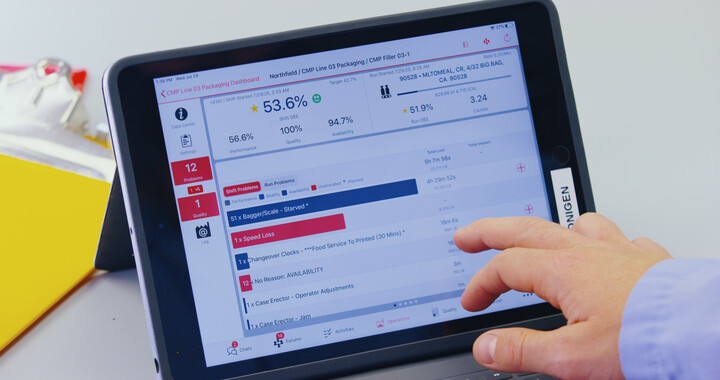
- Calculate the target and deploy visual controls: Divide your net available working time by your true customer demand to establish your precise operational rate. Once you calculate this number, install visual management tools, such as andon boards (physical or built into manufacturing software), in the production area. These boards display real-time metrics by comparing your target plan against actual output. If the line falls behind the established rhythm, workers or connected workforce software can immediately signal abnormalities.
- Execute continuous loop adjustments: Treat your takt time as a living system rather than a permanent fix. Review the line data daily to spot shifting bottlenecks, sudden demand spikes, or unexpected capacity losses. Reallocate tasks between workstations dynamically, cross-train your personnel, and continually optimize the workflow to keep your internal cycle times locked tightly to the external market pulse.
The Bottom Line
Takt time provides the precise rhythm your organization needs to harmonize internal operations with external market demand. Deploying this Lean metric transforms chaotic, unpredictable workflows into streamlined, efficient systems that naturally eliminate waste and stabilize inventory. By aligning your team to a singular, demand-driven heartbeat, you protect your bottom line while consistently delivering value to your customers.
To see how visual management tools and connected workforce software can synchronize your floor to your optimal cadence, book a demo today.

Frequently Asked Questions
How often should you change your takt time?
You should recalculate and adjust your takt time whenever a significant, sustained shift in customer demand or operational capacity occurs. While Toyota reviews and tweaks its takt time every 10 days, standard practice is adjusting it during regular monthly or quarterly production planning cycles.
Does takt time include worker breaks or downtime?
No. When calculating takt time, you must subtract all planned, non-productive periods, such as lunch breaks, morning meetings, scheduled machine maintenance, and shift cleanups, to calculate net available time. Including downtime artificially inflates your takt time and sets an unachievable production pace.
Can you apply takt time in a software or service role, such as a help desk?
Yes, absolutely. In service environments, you swap physical parts for tasks, tickets, or customer interactions. For example, a help desk can calculate takt time by dividing total working minutes by incoming customer support tickets. This calculation determines exactly how often a representative must resolve a ticket to keep the queue from backing up.