How Agentic AI Is Transforming Frontline Manufacturing Operations


.webp)

published
September 1, 2026
Key Takeaways
AI delivers the most value in manufacturing when it is applied to frontline decision‑making, not just automation.
AI is a practical solution to manufacturing labor shortages by scaling expertise and reducing frontline strain.
Agentic AI in manufacturing can turn everyday frontline communication into measurable productivity gains
For manufacturers struggling with chronic downtime, labor shortages, and inconsistent performance, adopting AI is no longer optional—it’s essential to survival.
At this critical inflection point, agentic AI and generative AI (GenAI) are delivering powerful new capabilities that can solve some of manufacturers' largest, most complex, and most intractable problems.
The manufacturers who win with modern AI will apply it to frontline decision-making rather than stopping at automation.
The Changing Role of AI in Manufacturing
Manufacturers have used AI to improve productivity for decades. Predictive maintenance AI, such as monitoring pumps or motors to predict failures, has prevented downtime incidents in factories for 40 years. Collaborative robots, or "co-bots," joined manufacturing teams about 25 years ago to automate material handling, including moving components from warehouses to production lines more safely and efficiently than humans can.
Agentic and GenAI are a giant evolutionary leap from those earlier AI technologies. Far from the old rules-based systems that enable a narrow set of capabilities, agentic AI doesn’t just analyze data—it observes what’s happening, identifies emerging problems, and recommends or initiates actions automatically.
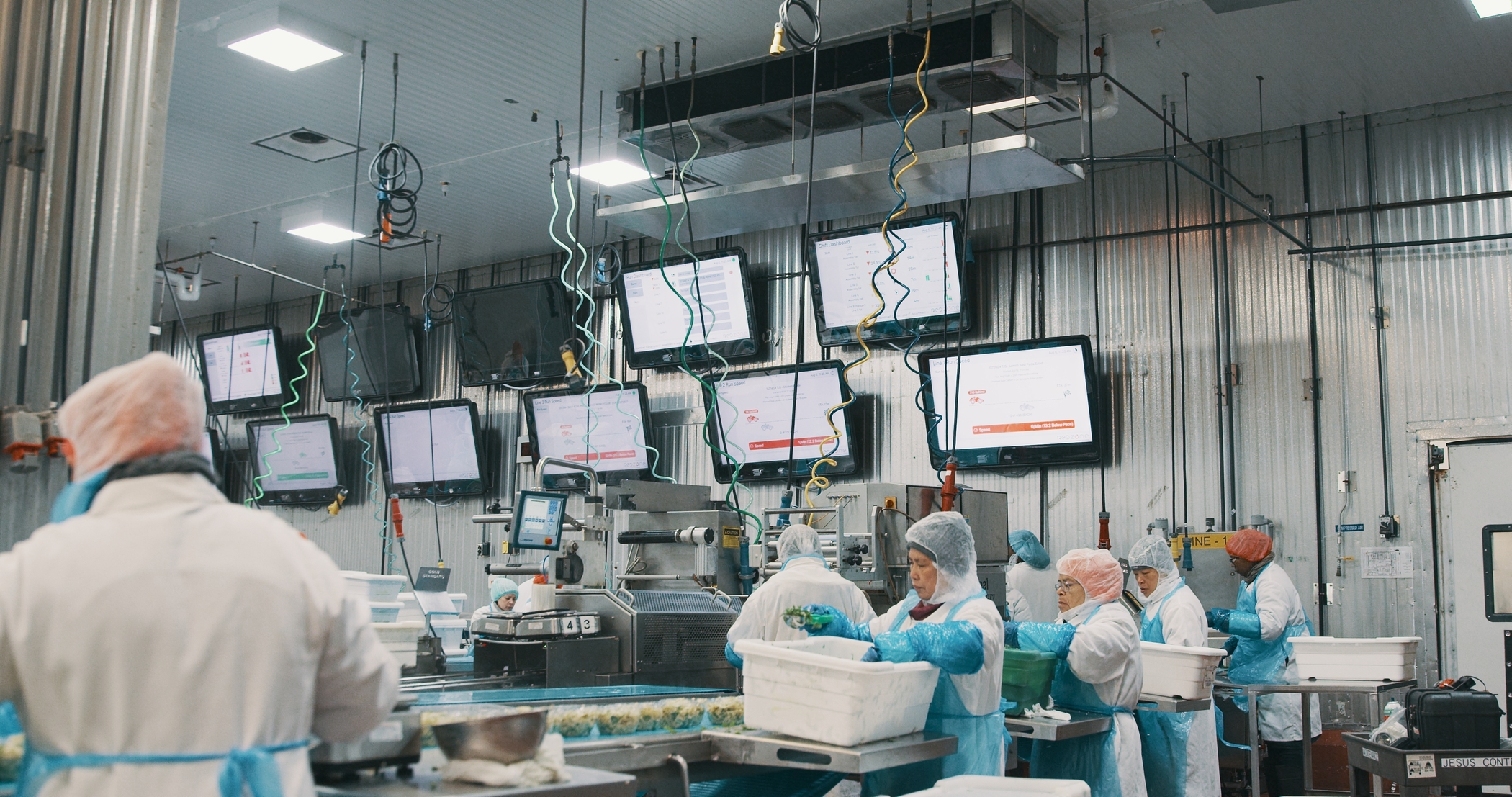
While AI’s technical capabilities are advancing rapidly, its greatest impact is being felt where manufacturers hurt the most: the frontline manufacturing workforce.
{{callout1}}
How AI Solves Manufacturing Labor Shortages and Productivity Gaps
The manufacturing skills and labor gap is an urgent problem that AI can help solve. Baby Boomers are retiring and younger generations aren't joining the industry, so there are more than 400,000 unfilled manufacturing positions. Unless current workforce challenges are addressed, 1.9 million manufacturing jobs may go unfilled by 2033, Deloitte predicts.
Without new ways to scale expertise and reduce worker strain, these workforce gaps will continue to widen. The latest AI technologies will not merely fill frontline jobs but also create a happier, more productive, skilled, and loyal manufacturing workforce.
8 Ways AI Improves Frontline Manufacturing Productivity, Safety, and Retention
Frontline workers comprise 50% to 80% of an average manufacturer's workforce, making them a significant line item on the financial statement. By making, inspecting, and delivering the product, they also directly affect productivity, efficiency, quality, and customer satisfaction.
Frontline workers share a lot of know-how in unstructured data, including notes in production logs and other workplace software. By unlocking and structuring that data, agentic and GenAI empower the frontline manufacturing workforce with the right information at the right time to optimize production and solve problems. Here are some ways AI technologies are helping manufacturers do just that.
- Retain Expertise Even After Retirement: AI captures veteran workers' know-how from logs and chats and makes it searchable for newer operators. This extends the useful life of frontline workers' expertise long after they leave.
- Speed Employee Onboarding and Training: AI captures veteran workers' know-how from logs and chats and makes it searchable for newer operators. This extends the useful life of frontline workers' expertise long after they leave.
- Give Workers Access to Familiar Technology: AI provides frontline workers the right answers instantly using common words and familiar technology.
- Eliminate Language Barriers Across the Diverse Workforce: AI translates chats, work instructions, training, and other information into multiple languages in real time to prevent miscommunications that create safety and quality risks.
- Solve Problems Before They Happen: AI evaluates data in real time to surface early signals of trouble and recommend actions to prevent problems before they materialize.
- Achieve Production Consistency by Uncovering Hidden Gems: AI exposes hidden influences on quality and overall equipment effectiveness (OEE) to improve coaching, narrow performance gaps, and achieve product consistency.
- Optimize Supervisor Workloads to Prevent Burnout: AI handles basics like routine communications, data gathering, and anomaly detection, so frontline supervisors can focus on more meaningful duties.
- Improve Workers’ Job Satisfaction by Reducing Stress: AI tools make production more dependable to reduce stress, dissatisfaction, burnout, and turnover.
Where AI Fails in Manufacturing—and How to Avoid Mistakes
AI is very powerful, and manufacturers who delay risk their competitive advantage. But that doesn't mean you can just throw AI at a manufacturing plant and hope for the best.
Failures in AI implementation often stem from starting with a tool rather than focusing on a defined business objective or problem. Avoid generic, low-value solutions, such as checking emails or managing expense reports, and focus on high-spend areas, such as labor productivity, material utilization, or first-time quality; these are big business problems where generative and agentic solutions deliver massive value.
AI also won't fix culture issues like toxic, disrespectful leadership, poor compensation, or distrust. Reaching for AI rather than fixing difficult human problems may make things worse. For one, it signals to employees that their employer is ignoring their most pressing problems. It may also heighten anxieties about whether AI will replace workers.
Effective AI initiatives start with real frontline problems and augment human judgment rather than trying to replace it.
{{callout2}}
ChampionAI: Applying Agentic AI to Frontline Manufacturing in Real Time
The best outcomes come from using AI as a tool to help workers do their jobs better. Recently, Redzone has been piloting ChampionAI, and the initial results are so impressive that we're rolling it out to more than 2,000 manufacturing sites in the coming weeks.
ChampionAI helps manufacturers predict downtime events, identify root causes, and recommend solutions. It does this by using generative AI, machine learning (ML), and agentic AI to analyze active communications in a factory’s Redzone manufacturing software and surface critical information instantly. Unlike other analytics tools, ChampionAI works inside the flow of daily frontline communication, not after the fact.
For example, ChampionAI helped early adopter Crest Foods identify power glitches, a major problem that was documented only through Redzone chats. Before ChampionAI, operators logged the issue in Redzone, but no one connected the dots to see the pattern. By spotting issues that don't appear in a standard downtime report, ChampionAI puts billions of valuable data points into immediate action.
Our research shows that manufacturers achieve 26% average productivity improvement 90 days after deploying Redzone. Early pilots indicate that ChampionAI will produce an additional 5% or 10% labor productivity gain.
The Bottom Line
Investing in frontline employees with next-generation tools like ChampionAI helps solve manufacturing productivity, employee retention, and skills gaps. This creates a positive "flywheel effect," where higher productivity leads to higher engagement and retention.
In the next era of manufacturing, competitive advantage will belong to companies that invest in their frontline workers as decisively as they invest in machines. See how ChampionAI can transform your frontline.


.jpg)