Ending the Productivity Plateau: Inside Integrated Digital Ecosystems


publicado
October 15, 2026
For decades, the manufacturing sector has poured billions of dollars into digital systems of record, internet-connected machinery, and advanced sensors. Yet, the promised digital revolution has failed to move the needle on the most critical metric: productivity.
A major culprit of this productivity plateau is the fragmentation of data. Sensors and digital tools are producing immense amounts of data, but this information is trapped in siloed systems — isolated islands of data that human workers must manually sift, interpret, and implement. This has created a productivity ceiling that digitization alone cannot break through.
Read parts 1 and 2 of this series:
- Breaking the Productivity Ceiling: The Power of Software-Defined Automation
- Beyond Automation: Why Industry 5.0 Is Human-Centric
In 2026, a new paradigm of integrated digital ecosystems is emerging. By weaving together isolated tools into a combined digital thread, manufacturers are finally gaining the actionable intelligence required to thrive in a hypercompetitive global market.
From Isolated Automation to Unified Data Ecosystems
Modern manufacturing has evolved beyond simply "going digital" as industry leaders are no longer satisfied with merely replacing paper with screens. They are building a digital ecosystem where data flows seamlessly from the initial product design to how it's performing in the field.
The shift from isolated systems to integrated ecosystems is driven by documenting ROI. Merely digitizing paper records changes the data's format, but it does not change the impact of data on the business. The true value lies in unifying these systems so that manufacturers can gather insights across production lines, an entire plant, or even multiple sites to drive measurable improvements.
Recent research by Nucleus Research identified a clear and measurable ROI divide in frontline execution performance. Nucleus segmented organizations based on their adoption of 5 core digital frontline practices: work instruction delivery, training, real-time guidance access, skills and certification tracking, and task completion. The survey highlights the massive gap between leading adopters and companies still lagging behind:
- Productivity: Companies that integrate 4 or more core digital frontline practices report a 20 percentage-point advantage in productivity.
- Operational health: These "Leading Adopters" also reduce downtime by 11 points and rework by 5 points.
- Workforce improvements: Leading adopters are nearly 2x as likely to retain workers and 1.5 times more likely to realize compliance and audit gains.
Despite these clear benefits, a significant divide remains. Fewer than 40% of companies globally prioritize investing in smart manufacturing platforms and digital ecosystems. That means over half of all manufacturers still struggle with siloed systems that directly hurt their bottom line.
3 Digital Pillars of Scalability
To close the productivity gap, the modern digital ecosystem relies on 3 foundational pillars: predictive maintenance, workforce training, and enterprise-scale systems. Together, these tools form a resilient infrastructure that minimizes waste, closes the skills gap, and scales operations with unprecedented agility.
Predictive Maintenance: Prescriptive Action
Predictive maintenance continuously analyzes equipment data to anticipate failures and schedule repairs before breakdowns occur. Moving from reactive repairs to prescriptive action increases a machine's lifespan by 20%–40%, McKinsey reports. In 2026, this is a baseline requirement for avoiding unplanned downtime that restricts output.
Workforce Training: Closing the Talent Gap
As technology grows more complex, humans' skills must keep pace. Training has shifted from a single onboarding event to a continuous digital process. Manufacturers already spend $32 billion annually on internal and external training programs, according to the Manufacturing Institute's 2026 workforce training study. Despite this investment, 42% of manufacturers still cite skills shortages as a primary barrier to digital transformation, finds Alithya’s "2026 Manufacturing Trends and Analysis Survey." Connected tools can fill the gap by accelerating learning opportunities across their workforce.
Enterprise-Scale Systems: The Flexible Infrastructure
Cloud-native, enterprise-scale software gives leaders access to live plant-floor data from any location, providing the flexibility to optimize resources instantly to gain competitive advantages. Roughly 75% of ERP deployments are cloud-based, finds Panorama’s "2026 ERP Report." Unifying shop-floor execution with business planning helps manufacturers improve data accuracy and performance as they grow.
Case Study: Empowering the Frontline at Jel Sert
Food and beverage manufacturer Jel Sert is bridging the execution gap with integrated digital tools. The company replaced its paper logs with digital huddles and live OEE dashboards for operators by combining a connected workforce solution with its existing ERP.
This transformation moved the plant from analyzing yesterday's data to fixing today's problems. Within 90 days, Jel Sert achieved a 9-point increase in OEE and boosted output by over 20% without increasing its labor footprint.
IIoT: The Operational Foundation of the Modern Factory
At the heart of this integrated digital ecosystem is the Industrial Internet of Things (IIoT). IIoT utilizes a network of sensors, actuators, and edge computing to transform raw mechanical processes into actionable intelligence.
IIoT leverages 4 critical technology pillars to transform factory functions:
- Edge computing and low latency: IIoT uses edge computing to process data directly on the machine. By reducing latency, edge enables operators to make safety stops or quality adjustments immediately.
- Predictive maintenance: IIoT systems use AI to monitor vibration, heat, and acoustics to predict failures before they happen. AI-driven predictive maintenance can reduce unplanned downtime by up to 45% and maintenance costs up to 30%, according to IBM, citing IDC.
- Asset visibility: More affordable sensors allow companies to track machine variables across the entire plant (and even across sites), eliminating blind spots in the factory where unknown losses occur.
- Digital twins: IIoT provides the real-time data stream necessary to power digital twins of physical assets. These allow engineers to simulate what-if scenarios and optimize production cycles without ever touching a physical machine.
The financial impact of IIoT implementation is staggering. The global IIoT market is projected to reach $751 billion in 2026. Early 5G-enabled IIoT adopters have seen operating cost decreases up to 90% and productivity gains as high as 245%.
Case Study: Schneider Electric’s EcoStruxure Ecosystem
Schneider Electric’s Normandy, France, factory was plagued by energy waste and reactive maintenance due to managing thousands of product configurations on legacy machinery.
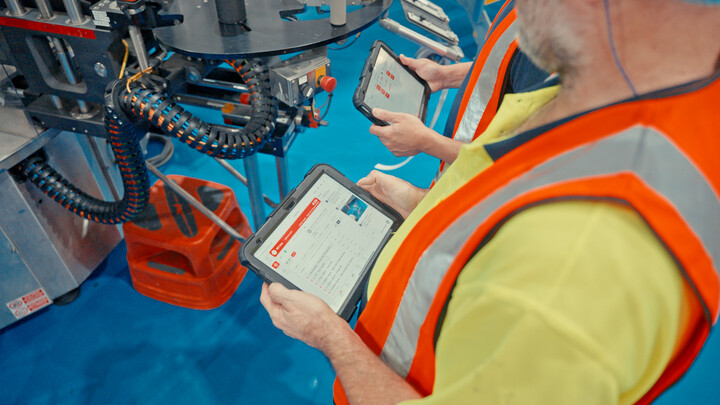
Schneider Electric implemented its own IIoT platform, called EcoStruxure, to turn the plant into a data-driven powerhouse. The company retrofitted brownfield legacy machines with thousands of wireless sensors to monitor vibration, temperature, and electricity-current draw without requiring expensive rewiring. Maintenance technicians use tablets equipped with augmented reality (AR) and IIoT data overlays to display real-time equipment insights, highlighting any component that is failing. IIoT meters track energy usage down to the individual machine level, feeding data into AI models that optimize HVAC and lighting based on occupancy and production load.
The EcoStruxure IIoT Ecosystem helped the plant reduce energy consumption up to 30% and decrease maintenance costs by 30%. By switching from scheduled to IIoT-driven predictive maintenance, the plant saw a 20% reduction in mean time to repair (MTTR). Schneider Electric's experience shows how companies can upfit existing factories with IIoT technology to drive energy savings directly to the bottom line. In 2026, a smart manufacturing factory is measured by how intelligently it uses resources, not just by how fast it can build.
Improving Productivity Through Effective Execution
Many companies are frustrated when their modernization efforts don't move the productivity needle. Commonly, they deploy the right digital technology, but execution suffers because it — and its results — remains siloed. Real, measurable change demands effective execution built on connected data. Execution is the bridge between conceptual hope and operational reality, determining whether advanced smart manufacturing technologies deliver ROI or remain expensive experiments.
This is evident from the Nucleus Research survey: Companies that have implemented at least 4 of the 5 core digital frontline practices "operate with greater consistency, control, and scalability, while those relying on fragmented tools and informal processes continue to face constraints in workforce readiness, process standardization, and overall performance." A single capability does not drive these differences; rather it's an organization's ability to connect training, task execution, and compliance into a unified execution model.
Connected workforce systems help companies dismantle the data silos that commonly choke operational speed. These technologies transform a factory from a collection of isolated machines into a responsive, intelligent ecosystem capable of scaling production without a proportional increase in overhead.
In 2026, the most successful manufacturers are those who view these tools not as separate purchases, but as a unified ecosystem. The cloud hosts the data, predictive AI analyzes it, and a digitally upskilled workforce acts upon it. The future of manufacturing is about building a more unified world through the seamless flow of data instead of just building smarter machines.