Continuous Manufacturing: Definition, Examples & Pharma Uses



.webp)
published
July 27, 2026
Key Takeaways
Continuous manufacturing makes product in one nonstop flow: raw materials in one end, finished product out the other, with no pause between steps.
Batch processing stops between steps. That is the whole difference, and it is why continuous lines run faster and waste less at high volume.
Continuous manufacturing costs less per unit at scale. Researchers report switching cuts total costs by 30% to 50%.
Oil, chemicals, and paper have run continuously for decades. Pharma is the newest adopter, now backed by the FDA's ICH Q13 guidance.
The equipment is not the hard part. A nonstop line pays off only if operators have real-time data to catch problems before they become scrap product.
What Is Continuous Manufacturing?
Continuous manufacturing is a production method in which materials move through every processing step in a steady, unbroken stream. There is no pause to complete one batch before the next begins. Instead, a single integrated line handles mixing, forming, and finishing as a coordinated flow. It is one of the core types of manufacturing production methods.
Batch production, another core production method, makes a set quantity of product by running it through the whole process together, then stops to clean or reset the line before the next batch. Continuous manufacturing never stops to reset. Material keeps flowing through every step, so product comes off the line at a steady rate rather than in separate lots. The approach fits products made in large, standardized volumes, where the line can run for long stretches without a changeover. It pairs naturally with Lean manufacturing because a continuous flow removes the waiting that batch steps create.
{{callout1}}
Continuous Manufacturing vs. Batch Manufacturing
The core difference is whether the line stops. Batch processing makes one set quantity at a time, then stops to reset the line before the next run. Continuous manufacturing keeps materials moving through every step at once.
Each approach has a place, and many plants run both.
Neither method wins outright. Batch processing is the better choice for small volumes, frequent product changes, and complex formulations. Continuous manufacturing earns its cost when a product runs often enough to keep the line moving. That steady flow is also what makes just-in-time production practical, because output can follow demand instead of piling up as inventory.
Continuous Manufacturing Examples
Continuous manufacturing is easiest to picture in the industries that have used it for a century. Two common examples:
- Chemical processing: Continuous reactions produce fertilizers, plastics, and industrial chemicals that would be impractical to start and stop.
- Food and beverage: Sauces, beverages, and other high-volume goods move through cooking, filling, and packaging on continuous lines.
Pharmaceuticals is the newest adopter, as more companies move selected drugs from batch to continuous lines.
Continuous Manufacturing in Pharma
Pharmaceutical production has been slower to change than other industries. For decades, drugmakers synthesized active ingredients, shipped them, and converted them into pills in separate batches, a sequence that can take weeks or months per lot.
Regulators and manufacturers now see continuous manufacturing as a way to compress that timeline and tighten quality control.
Why Pharma Is Moving to Continuous Manufacturing
The proof of concept came out of the lab. Researchers at the Novartis-MIT Center for Continuous Manufacturing built an end-to-end prototype that turned raw ingredients into finished tablets on a single line.
A 2025 review of continuous pharmaceutical manufacturing reported up to a 70% smaller equipment footprint, a 3- to 5-fold increase in volumetric productivity, and 30% to 50% lower facility costs than batch.
Beyond cost, continuous lines reduce batch-to-batch variability, shrink the plant footprint, and make it easier to scale a drug up or down with demand. Because the line is monitored in real time, an out-of-spec event affects only the product made during that window. Operators can divert and reject that small amount while the line keeps running, instead of putting an entire batch on hold.
ICH Q13 and FDA Guidance
Regulation has caught up with the science. The FDA adopted ICH Q13, the international guideline for continuous manufacturing of drug substances and products, in 2023. It gives companies a clear path for control strategy, process validation, and real-time monitoring.
The ICH quality guidelines frame the benefits the same way manufacturers do: faster development, better tools to assure product quality, and a response to drug shortages. Meeting them takes the same discipline as GMP compliance — detailed, real-time records of every step, backed by compliant electronic records and a quality management system.
{{callout2}}
Benefits and Limitations of Continuous Manufacturing
Continuous manufacturing is a strong fit for some operations and a poor one for others. Here are some of the trade-offs.
Benefits
- Faster production: No stops between steps means no waiting, so cycle times drop.
- Consistent quality: In-line monitoring holds quality parameters steady and flags drift before it reaches the finished product.
- Lower cost at volume: Once the line is running, less labor, downtime, and material waste lower the cost of each unit.
- Smaller footprint: One integrated line fits in less space and creates less waste than a chain of separate batches.
Limitations
- High upfront investment: Designing an integrated line and its controls takes significant capital and engineering before the first unit ships.
- Poor fit for low volume: Frequent product changes and small, custom runs still favor batch processing.
- Heavy monitoring demands: Continuous lines depend on real-time monitoring and process analytical technology; without them, a deviation runs on undetected.
Making Continuous Manufacturing Work on the Floor
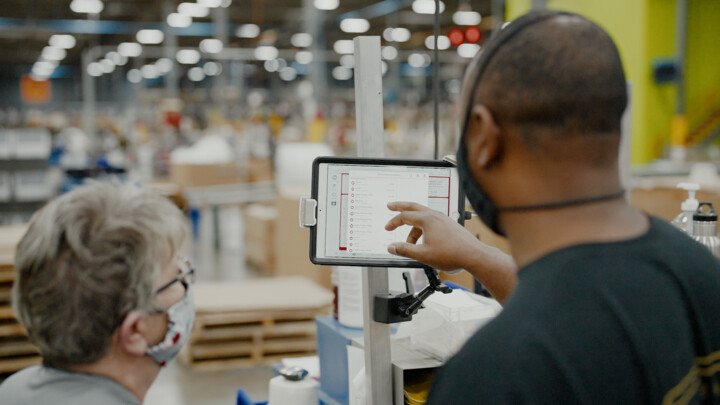
The equipment is only half the story. A line that never stops gives operators no natural pause to inspect a finished lot; the team has to watch quality as the product flows. That shifts the work toward real-time control — and toward the people doing it.
Process analytical technology measures critical parameters like temperature, pressure, and flow as they change, but the data only helps if the frontline can act on it. Operators who see a trend heading out of spec and correct it early are what keep a continuous line from scrapping product at scale.
The same principle shows up in overall equipment effectiveness (OEE): The number matters, but the improvement comes from the team using it. It is the same connected, real-time visibility behind a smart factory — data in front of the operators watching the line, not locked in a report.
The Bottom Line
The mistake is treating continuous manufacturing as an equipment upgrade, when the machines are the easy part. What decides whether it pays off is control. A line that never stops only helps if operators can catch a problem as it forms, before it becomes a run's worth of scrap.
So the real question isn't whether continuous is the future of manufacturing, but whether you have a product steady enough to earn the switch and a floor team ready to watch it live.
See how Redzone compliance helps pharmaceutical teams monitor continuous processes and keep every run audit-ready.

Frequently Asked Questions
What is discrete vs. continuous manufacturing?
Discrete manufacturing makes countable, separate items like cars or phones, usually on an assembly line. Continuous manufacturing produces a nonstop flow of material, like fuel or tablets, with no gaps between units. The difference is whether you can count the output as individual pieces.
Is continuous manufacturing cheaper than batch manufacturing?
At high volumes, continuous manufacturing is less expensive than batch. One uninterrupted line lowers cost per unit by cutting labor, downtime, and material waste. A 2025 review reports 30% to 50% lower greenfield facility costs than batch. The upfront investment is steep, so it fits high-volume products best.
What companies use continuous manufacturing?
In pharma, Vertex, Janssen, and Pfizer have all won FDA approval for continuously made drugs, building on the Novartis-MIT research. Outside pharma, oil refiners, chemical producers, and paper mills have run continuous lines for decades.
Is continuous manufacturing FDA-approved?
Yes. The FDA actively encourages it and adopted the ICH Q13 guideline for continuous manufacturing in 2023. The agency has approved multiple drugs made on continuous lines and treats the method as a way to improve quality and ease drug shortages.
How do companies switch from batch to continuous manufacturing?
Most start with a single product line, redesign the process as an integrated flow, and add real-time monitoring to control quality. In pharma, companies validate the new process with regulators under ICH Q13 before scaling to full production.