Smart Factories: How They Work, Benefits, and Technologies


.webp)
published
July 31, 2026
Key Takeaways
A smart factory is a connected, data-driven production environment where machines, systems, and frontline workers share real-time information to run and improve operations.
Smart factories are the shop-floor expression of Industry 4.0, built on cyber-physical systems that link the physical line to a live digital model of it.
The Industrial Internet of Things (IIoT) is the backbone: Connected sensors and devices generate the data that AI, analytics, and automation turn into action.
Less unplanned downtime, higher OEE, faster changeovers, and steadier quality are the payoffs.
Technology alone does not make a factory smart. The advantage comes from frontline teams using connected data to make faster, better decisions.
Manufacturers have poured billions into connected sensors, data platforms, and automation over the past decade, yet US manufacturing productivity still sits about 4% below its 2010 peak, and 70% of manufacturers still collect production data manually. The data piles up; acting on it while a shift is still running is where most plants stall.
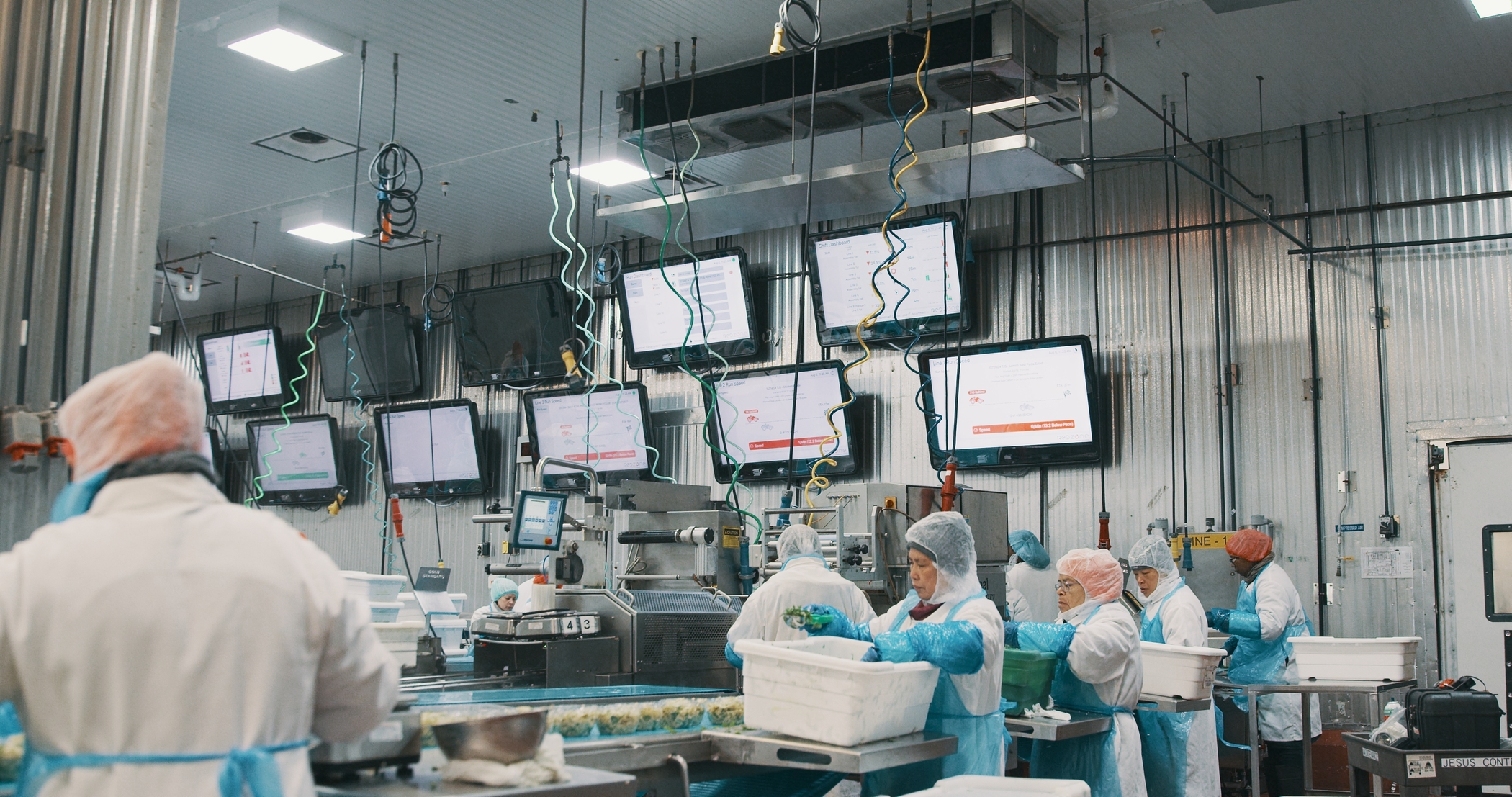
A smart factory closes that gap. It connects machines, software, and the people running the lines so that information turns into action while the work is still happening, not in a report the next morning.
What Is a Smart Factory?
A smart factory is a highly connected, digitized production environment where machines, systems, and people continuously share data to run and improve operations. Rather than relying on end-of-shift reports, it senses what is happening in real time, analyzes it, and adjusts, often automatically.
Smart factories are a clear example of Industry 4.0, the Fourth Industrial Revolution the World Economic Forum helped define. Technically, each factory is a cyber-physical system. Digital models and software mirror real machines and equipment, collecting data, interpreting it, and feeding decisions back to the floor.
4 traits separate a smart factory from a plant that happens to have some connected equipment:
- Connectivity: Everything on the floor talks to everything else, so data moves without manual reentry.
- Intelligence: AI and analytics read the data for patterns, alerts, and predictions instead of leaving people to sift raw numbers.
- Flexibility: The system adapts to changes in demand, mix, or conditions rather than running one fixed routine.
- Sustainability: Tighter control over energy, materials, and scrap reduces waste as a byproduct of running well.
{{callout1}}
How Do Smart Factories Work?
A smart factory works by turning shop-floor activity into data, data into insight, and insight into action, on repeat. The loop runs in 4 stages:
- Connect and collect: Industrial Internet of Things (IIoT) sensors, machines, and connected workers generate real-time data on output, downtime, quality checks, and equipment condition. This is where IoT does its work in a smart factory — giving the rest of the system accurate intelligence to act on.
- Analyze: AI and analytics turn raw signals into patterns, alerts, and predictions, such as flagging a machine drifting out of spec before it fails.
- Decide and act: Operators and systems respond to what the data shows. Some responses are automatic; others put a clear recommendation in front of a person who makes the call.
- Learn and improve: Each cycle sharpens the next, so the factory gets better at spotting and preventing problems over time.
Two systems make that loop concrete. A manufacturing execution system (MES) translates production plans into tracked shop-floor tasks, while a digital twin keeps a live virtual model of a line or asset, so teams can test changes and catch trouble before it reaches the floor.
Benefits of a Smart Factory
The benefits of a smart factory show up in the numbers operations leaders already track, not in abstractions.
- Less unplanned downtime: Continuous monitoring feeds predictive maintenance, so teams catch wear before it becomes a breakdown.
- Higher OEE: Real-time visibility into availability, performance, and quality makes losses easier to find and fix, which lifts overall equipment effectiveness (OEE).
- Faster, more flexible changeovers: Quick, data-guided changeovers make smaller batches economical, so production can follow real demand instead of long frozen schedules.
- Steadier quality: Connected quality checks and full traceability catch defects earlier and make root-cause analysis faster when something slips.
- A more capable frontline: Frontline teams get the data and context to solve problems in the moment, which raises both output and engagement.
- Lower waste: Tighter control over energy and materials trims waste and supports sustainability goals without a separate program.
Manufacturers keep investing in smart manufacturing specifically to improve competitiveness, according to Deloitte, which is why adoption keeps widening the gap between early movers and everyone else.
{{callout2}}
Smart Factory Technologies
No single tool makes a factory smart. A working smart factory layers several technologies so that data can move from the machine to a decision and back:
- IIoT: The connective layer. Sensors and connected devices link machines, tools, and workers, so the whole floor shares one stream of data.
- AI and machine learning: The interpretation layer. Models find patterns humans would miss, and agentic AI can now take routine actions on its own, within limits people set.
- Advanced analytics: Dashboards and KPIs that make the data usable. Analytics turns raw readings into trends operators and supervisors can act on.
- Digital twins: Virtual replicas of a line or asset. They let teams simulate changes and predict failures before committing on the floor.
- Cloud and edge computing: The infrastructure that stores and processes data at scale. Edge computing handles time-sensitive decisions close to the machine.
- Robotics and software-defined automation: Machines that handle repetitive or hazardous work. Increasingly, they're reconfigured through software rather than hardware.
- Connected workforce software: The layer that connects the people running the lines. Connected workforce software lets operators flag issues, share fixes, and feed frontline knowledge back into the data.
The Bottom Line
The phrase "smart factory" puts the spotlight on the technology, but the factories that actually get smarter are the ones where the people on the line can see the data and do something with it. Sensors and AI generate the signal; frontline teams close the loop. Invest in the tech, yes, but don’t forget to invest in the people, too, or you’ll end up with an expensive dashboard nobody uses.
See how Redzone's software connects operators, machines, and data, so your teams turn real-time insight into action and lift productivity 26% in 90 days.

Frequently Asked Questions
What is an example of a smart factory?
A smart factory can be a full plant or a single line. An automaker running a connected, digital-twin-planned factory is one example; so is a food or beverage line using IIoT sensors, real-time monitoring, and connected workers to cut downtime. Data drives the action in both.
How does IoT work in a smart factory?
IoT connects a smart factory's machines, tools, and workers through embedded sensors and devices, known as the Industrial Internet of Things (IIoT). Those devices stream real-time data that AI and analytics use to monitor production and guide decisions on the floor.
Does the US have fully automated factories?
Not really. Some US plants run highly automated lines, but few, if any, operate with zero people. Smart factories automate data and routine decisions, yet operators still handle exceptions, judgment calls, and improvement, which is what turns automation into results.
What is the difference between a smart factory and smart manufacturing?
A smart factory is a specific connected facility. Smart manufacturing is the broader practice of using data, IoT, and AI across operations and the supply chain. The smart factory is where smart manufacturing shows up on the shop floor.
What is the definition of smart manufacturing?
Smart manufacturing is the use of connected data, IoT, AI, and analytics to run and improve production, often in real time. It spans the whole operation, from the shop floor to the supply chain. A smart factory applies those methods in one facility.

.jpg)