Standard Operating Procedures: What They Are and How to Write Them



.webp)
published
June 25, 2026
Key Takeaways
A standard operating procedure (SOP) is a documented, step-by-step instruction for completing a routine task the same way every time, no matter who performs it.
SOPs defend your operation against two costs that erode margin: inconsistent quality and knowledge that walks out the door when experienced people retire.
The strongest SOPs come from the people who do the work.
Writing the SOP is the easy part. The discipline is keeping it current, accessible, and used on the floor.
What Are SOPs?
A standard operating procedure is a documented set of step-by-step instructions that tells anyone in your organization exactly how to carry out a routine task or process. It removes the guesswork; a new hire on day one and a veteran on their thousandth run follow the same steps and produce the same result.
Think of an SOP as the single source of truth for how a job gets done. It defines what "good" looks like, the sequence to get there, and the checkpoints that confirm you arrived. When the answer to "how do we do this?" lives in one operator's head, you have a risk. When it lives in a clear SOP, you have a standard.
A well-built SOP usually includes:
- Purpose and scope: What the procedure covers and when it applies
- Materials and tools: Everything needed before starting
- Step-by-step instructions: Written in plain, active voice
- Safety and compliance requirements: Hazards, controls, and regulatory checkpoints
- Quality checkpoints: How to confirm each step meets the standard
- Roles and responsibilities: Who performs, reviews, and approves the work
- Revision history: Version, date, and owner, so you always know what's current
{{callout1}}
Why Are Standard Operating Procedures Important?
SOPs matter because the alternative is expensive. Without them, every task depends on who happens to be working, how they learned the job, and what they remember that day. That variation shows up as defects, rework, safety incidents, and failed audits.
SOPs earn their keep in four ways:
- SOPs make quality consistent: A documented procedure sets a baseline that holds through shift changes, employee turnover, and busy weeks. Performance no longer rises and falls with individual memory.
- SOPs speed up onboarding:. Bringing a new hire to full productivity is slow and costly, and good documentation does the heavy lifting. Organizations with a strong onboarding process improve new-hire productivity by more than 70%. Clear SOPs are how that onboarding happens on the floor.
- SOPs protect you in an audit (and on safety). SOPs create the paper trail that proves your process works in practice, not just on paper. A single serious OSHA violation can cost up to $16,550 per violation. Written procedures that build safety into each step are what stand between a near-miss and a citation.
- SOPs keep knowledge from walking out the door. When experienced people retire, the legacy knowledge locked in their heads tends to leave with them. SOPs capture that know-how while it's still on the floor, turning it into an asset the whole team can use.
Types of SOPs
SOPs come in a few formats. Match the format to the complexity of the task, not the other way around.
- Step-by-step (checklist) SOPs are simple numbered lists. They're used for linear tasks with no branching, like a line startup or an equipment cleaning routine. Most SOPs fit here.
- Hierarchical SOPs use a layered format for complex tasks, where each major step breaks into detailed substeps. Use it when a single step needs more explanation than a one-liner allows.
- Flowchart SOPs are decision maps for processes that branch, where the next step depends on a condition or outcome. Use it when the answer is often "it depends."
Standard Operating Procedure Examples
SOPs apply anywhere routine work requires consistent results. A few examples by function:
- Production: Machine changeovers, line startups and shutdowns, and product changeovers.
- Quality: Incoming material inspections, in-process quality checks, and handling a deviation or nonconformance — the backbone of any quality management system.
- Maintenance: Preventive maintenance task cards and equipment inspections that support total productive maintenance.
- Safety and compliance: Lockout/tagout, chemical handling, and sanitation procedures that hold up under GMP compliance and regulatory review.
{{callout2}}
How to Write SOPs
Writing a useful SOP is more about discipline than wording. Follow these steps to create standard operating procedures your team will trust.
- Pick the processes that most need an SOP first: You can't document everything at once. Start where standardization pays off most: high-frequency tasks, regulated work, jobs where mistakes are costly, and processes several people perform differently.
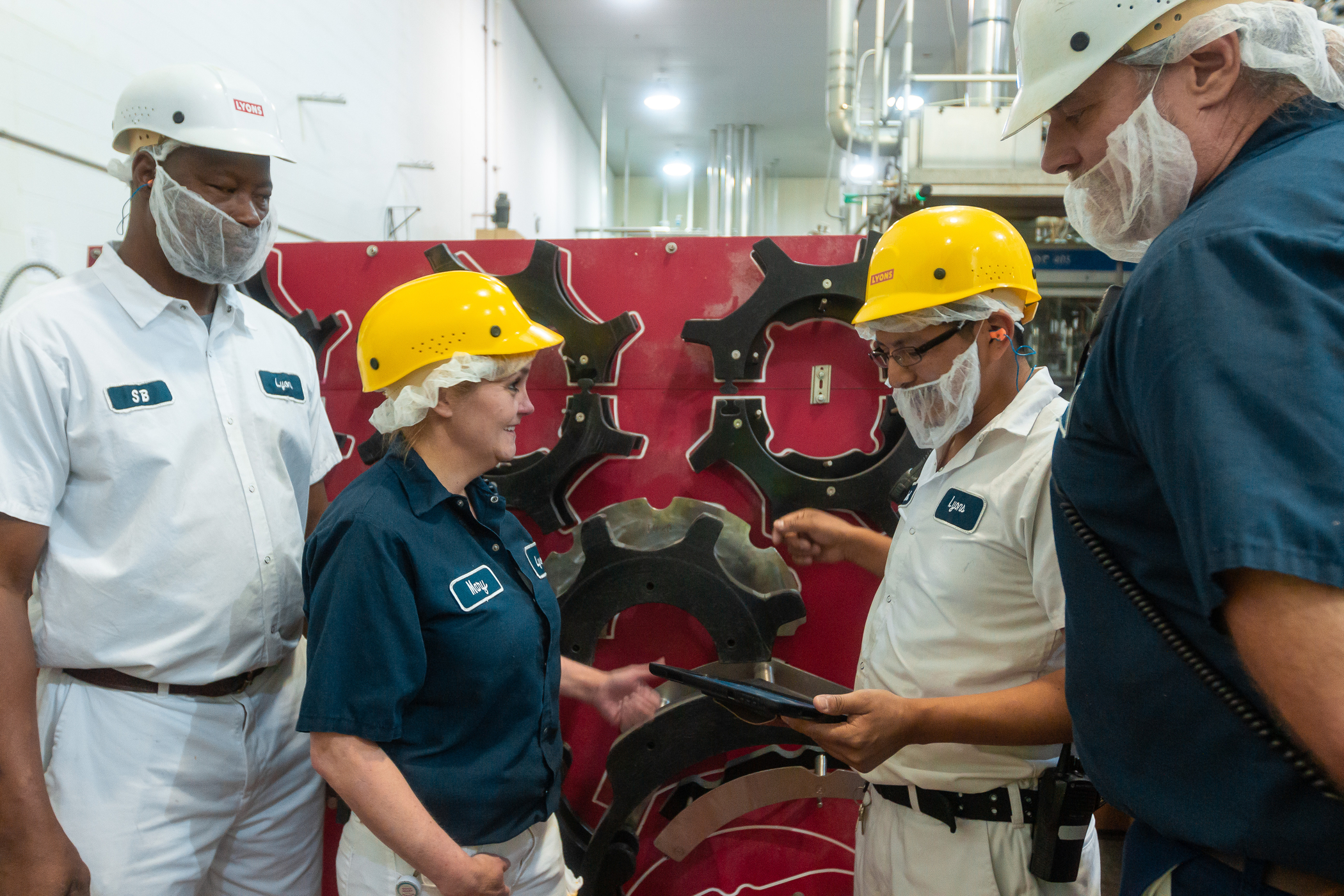
- Talk to the people who do the work: The best SOPs come from operators. The people on the line know the real sequence, the shortcuts that work, and the steps a manual would miss. Bring them in first.
- Choose a consistent format and template: Pick one layout and use it everywhere. When every SOP looks the same, anyone can follow any procedure without re-learning how to read it.
- Write each step in a plain, active voice: Use short, action-first sentences: "Inspect the seal," not "the seal should be inspected." One action per step. If a step needs a caveat, give it its own line.
- Test it with someone who has never done the task: Hand the draft to a person unfamiliar with the job and watch them follow it exactly as written. Every place they hesitate is a place your SOP is unclear.
- Review, approve, and assign an owner: Have a subject-matter expert check it for accuracy and a manager confirm it meets safety and compliance requirements. Then name an owner who is responsible for keeping it current.
- Make it accessible and keep it alive: An SOP buried in a shared drive helps no one. Put it where the work happens — at the machine, on a tablet, in the operator's hands — and review it on a set schedule, so it never drifts out of date.
Pros and Cons of Standard Operating Procedures
SOPs are worth the effort, but they aren't free of trade-offs. Going in clear-eyed helps you avoid failure modes.
Pros
- Consistency: You get the same result across shifts, sites, and people.
- Faster onboarding: New hires reach competence sooner with a clear guide.
- Compliance and safety: Built-in checkpoints and an audit-ready record happen naturally during daily operations.
- A baseline for improvement: You can't improve a process you haven't standardized first. SOPs give continuous improvement something to measure against, the same way overall equipment effectiveness (OEE) provides a baseline for equipment performance.
Cons
- They go stale: A procedure that doesn't keep pace with the process on the floor becomes a source of error instead of a guard against it.
- They can turn into box-checking: If people follow an SOP without understanding why, they go through the motions and miss the mistakes it was meant to catch. Explain the reasoning, not just the steps.
- Over-documentation slows you down: Not every task needs a formal SOP. Reserve them for work where consistency genuinely matters.
- Top-down SOPs meet resistance: Procedures handed down without input from the floor rarely get used. This is exactly why step two matters.
A bad SOP is worse than none at all because it gives false confidence while pointing people the wrong way. The fix isn't fewer SOPs; it's living ones.
SOPs vs. Work Instructions
People use these terms interchangeably, but they operate at different levels. An SOP governs an entire process — the what, the why, and the standard the work has to meet. A work instruction drops down to a single task inside that process and lays out exactly how to do it.
A "product changeover" SOP, for example, governs the entire changeover process: the sequence, the quality gates, and the sign-offs. The digital work instructions underneath it tell an operator precisely how to swap a specific tool or set a specific machine. You need both: the SOP for the standard, and the work instruction for the hands-on detail.
The Bottom Line
A standard operating procedure only delivers when people actually use it. It must be clear, current, and within reach at the moment of work. Manufacturers who treat SOPs as living tools on the floor get the most from them.
See how Redzone's digital work instructions put standardized, always-current procedures directly in your frontline's hands, and book a demo to see how it works on your lines.

Frequently Asked Questions
What are standard operating procedures?
A standard operating procedure (SOP) is a documented, step-by-step instruction for completing a routine task the same way every time. It tells anyone in your organization exactly how the work gets done, so quality stays consistent no matter who is on shift.
What are the steps to write an SOP?
Pick the process that needs one, talk to the people who do the work, choose a consistent format, and write each step in a plain, active voice. Then test it with someone unfamiliar with the task, approve it, and assign an owner to keep it current.
What is the difference between an SOP and a work instruction?
An SOP describes an entire process and the standard it must meet. A work instruction zooms in on a single task within that process and spells out exactly how to perform it. SOPs set the what and why; work instructions handle the granular how.
How often should SOPs be reviewed?
Review every SOP at least once a year, and sooner when something changes — new equipment, a regulatory update, a safety incident, or repeated confusion on the floor. An SOP that drifts out of date can be more dangerous than no SOP at all.
Who is responsible for writing an SOP?
Whoever owns the process drives it, usually with input from the operators who run the task day-to-day. A subject-matter expert reviews it for accuracy, and a manager signs off on safety and compliance before it goes live.