What Are Manufacturing Processes? Types and How To Optimize


.webp)
published
July 8, 2026
Key Takeaways
A manufacturing process is the method that turns raw materials into finished goods. The right one depends on your product, your volume, and how much your customers' orders vary.
Manufacturing processes get classified in 2 ways: how the material is shaped and how production is organized.
Optimizing a process starts with finding the constraint, standardizing the work, and making the floor visible in real time. Buying equipment comes later.
The biggest gains come from the people running the line. Give them current data and a clear standard, and they catch problems that are inexpensive to fix.
A manufacturing process is the specific method a company uses to turn raw materials into a finished product: The machines, steps, and sequence that get you from input to shippable goods. Some run in a single station. Others span dozens of stages, plants, and suppliers.
The process you choose affects your cost, your quality, and how quickly you can respond to changes in demand. It also determines how much capacity you lose to downtime. At a major automotive plant, an idle line can cost up to $2.3 million an hour, and most of that loss sits inside the process, not the product.
What Is a Manufacturing Process?
A manufacturing process is the defined set of steps, equipment, and labor a manufacturer uses to convert raw materials into a finished product. It covers the physical transformation (shaping, joining, finishing) and the way that work is organized across stations, shifts, and lines.
The terms "manufacturing" and "processing" sometimes get used interchangeably; It helps to separate them. Processing is any mechanical or chemical action that changes a material. Manufacturing is processing aimed at a finished product for a customer, almost always at scale. Refining crude oil is processing. Building a car is manufacturing.
Manufacturing processes are separated in 2 ways, and mixing them up adds confusion. The engineering view describes how the material is shaped, such as casting or machining. The operations view describes how production is organized, such as job shop, batch, or continuous.
{{callout1}}
The 6 Main Categories of Manufacturing Processes
Manufacturing processes fall into 6 main categories, each defined by how it shapes the material. Most products pass through several processes before they ship.
- Casting involves pouring molten metal or another liquid material into a mold and letting it solidify. It handles complex shapes at volume, such as engine blocks, pipe fittings, and cookware.
- Molding forms a pliable material, usually plastic or rubber, against or inside a mold. Injection molding and blow molding cover most plastic parts, from bottle caps to housings.
- Forming applies force to deform a solid material into shape without removing any of it. Stamping, forging, bending, and extrusion are forming operations used for car body panels, structural beams, and other parts.
- Machining removes material from a solid block to reach the desired shape. Turning, milling, and drilling are machining operations used wherever tight tolerances are required, such as engine components.
- Joining is connecting 2 or more parts into a single assembly. Welding, brazing, soldering, and adhesive bonding are joining processes, usually secondary steps after parts are made.
- Additive manufacturing, also called 3D printing, builds a part up layer by layer from a digital model. It suits low-volume, complex, or custom parts such as prototypes, medical implants, and tooling.
Surface treatment (coating, plating, and finishing) is almost always a finishing step rather than a way of forming a part. But it sometimes gets listed separately as a seventh manufacturing process.
The 6 Types of Manufacturing Processes (by Production Method)
The operations view sorts processes by how production is organized: By volume, variety, and how the work flows. Six types come up most often:
- Repetitive manufacturing: Dedicated lines run the same product at a steady rate with little changeover. It's common for durable goods such as appliances.
- Discrete manufacturing: Assembly lines build distinct, countable items, with changeovers to switch between models. Automotive, electronics, and toys run discretely.
- Job shop manufacturing: Workstations (rather than lines) produce small batches of custom work to order. Machine shops and custom fabricators are job shops.
- Batch manufacturing: A set quantity runs through together, then the line is cleaned or reset for the next batch. Pharmaceuticals, baked goods, and paint use batches.
- Continuous manufacturing: Production (usually for liquids, gases, or powders) runs nonstop. Oil refining, paper, and chemicals run continuously.
- 3D printing: It's used as a production method (not just for prototyping) when volumes are low and parts are complex or customized.
These manufacturing processes map to and work with the categories above. A continuous process might rely on casting and machining. Job shop might use forming and joining. Additive is the one method that sits on both lists: It shapes material and, increasingly, runs as a production mode in its own right. Naming the process and the category tells you how a part is made and how the making runs.
{{callout2}}
How To Optimize Manufacturing Processes
Whatever process you run, the gains come from the same discipline: Find what is slowing the line, fix it, and make the fix stick. Buying equipment comes last, not first.
1. Map the process and find the constraint: Walk the line and document each step, then find the bottleneck, the one station that sets the pace for everything else. Throughput can't run faster than that step, so that is where improvement starts. Value stream mapping is the usual tool, and you can't improve a process you haven't seen from start to finish.
2. Standardize the work: Document the process in a standard operating procedure. A standard is also the baseline you measure improvement against. Develop digital work instructions for each task, so quality doesn't depend on who happens to be working
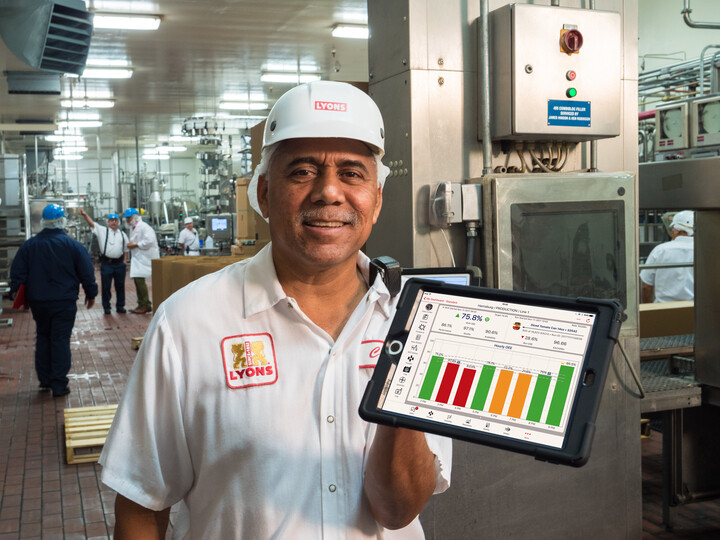
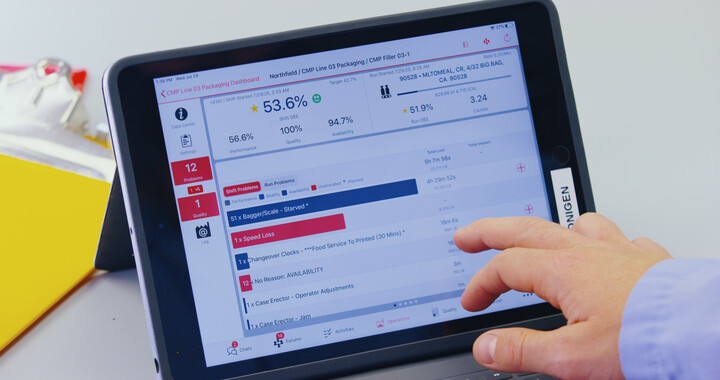
3. Make the floor visible in real time: Track output, downtime, and quality as they happen, not in a report the next morning. When a station falls behind, the people who can fix it should know within minutes. Overall equipment effectiveness (OEE) rolls availability, performance, and quality into one number: 85% is considered world-class, and most plants sit well below it, which is where the gains hide.
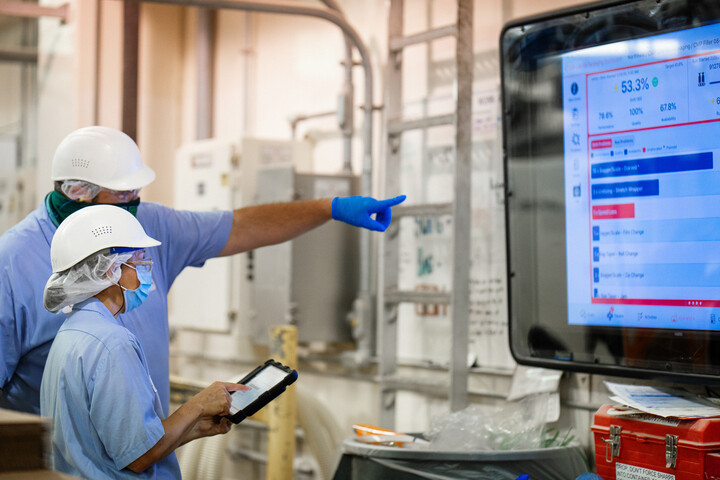
4. Put the data in front of the frontline: Operators see problems first. Give them the numbers and the authority to act, and they'll catch defects and slowdowns while they are still small. Technology helps here by surfacing the signal, while the judgment stays human.
5. Find root causes, not symptoms: When something breaks twice, run a 5 Whys root-cause analysis before you reset and move on. Fixing the cause keeps the same bottleneck from coming back next week.
6. Review on a set cadence: Treat optimization as continuous improvement, not a one-time project. Pick a weekly or shift-level rhythm to look at what slowed the line, then adjust the standard.
The thread running through these steps is that the people on the line, equipped with up-to-date data, do more for throughput than any piece of capital equipment.
The Bottom Line
No two plants run the same process, but they improve it the same way: The people on the line need to see a problem while they can still fix it. A standard the team follows and live numbers they trust separate a process you track on paper from one you run.
See how Redzone's connected workforce software gives frontline teams the visibility to do exactly that.