GFSI Certification Guide: Schemes, Requirements, and How to Choose



.webp)
published
July 27, 2026
Key Takeaways
GFSI doesn't issue certifications, rather it creates benchmarks that certification bodies use to certify food businesses.
Many retailers and food businesses require GFSI-compliant certifications, making it a commercial necessity for many food manufacturers.
Choosing the right certification depends on your primary market, production scope, and customer requirements — no single scheme is universally best.
Maintaining certification is an everyday operational discipline, not a one-time audit event. Documentation, training, and culture all play a role.
What Is GFSI?
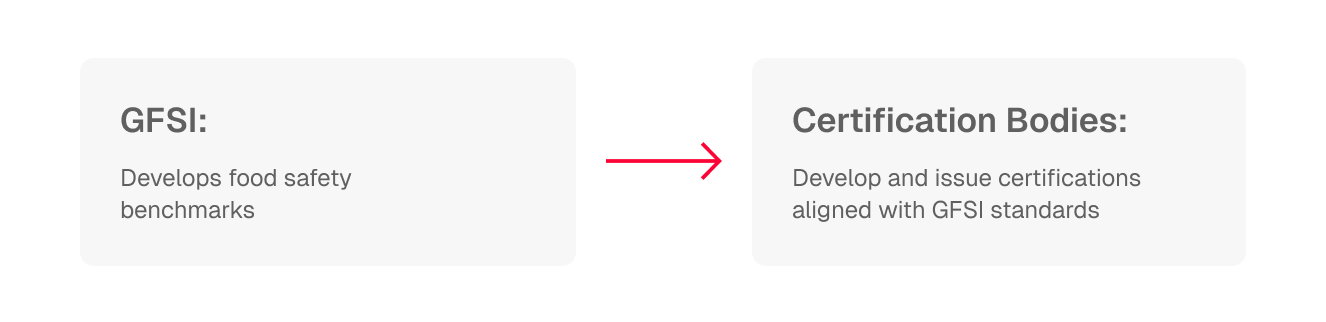
The Global Food Safety Initiative (GFSI) is a nonprofit trade organization that works to ensure safe food for consumers worldwide by harmonizing food safety standards across the global food supply chain. It creates benchmarks for food safety standards, which third-party organizations use as the foundation for certifications accepted across geographies, businesses, and scopes.
GFSI: Develops food safety benchmarks —> Certification Bodies: Develop and issue certifications aligned with GFSI standards
Currently, GFSI provides benchmarks for 20 different food-related scopes, including different types of farming, meat and plant product processing, food packaging, and retail/wholesale.
Rather than issuing certifications itself, GFSI establishes a set of requirements, or benchmarks, that food-related businesses must meet to receive a GFSI-recognized certification from a certification program owner (CPO), also called a certification body (CB). This system helps create consistency in food safety standards worldwide, allowing manufacturers, retailers, and suppliers to work within a common framework.
{{callout1}}
Why GFSI Recognition Matters to Food Businesses
At its most basic level, GFSI recognition demonstrates a company's commitment to producing food that meets safe consumption standards when it reaches the market. Beyond that, it has important business benefits, particularly for large or growing food manufacturers.
This is because many of the world's largest and most respected retailers require vendors to have a current GFSI-compliant food safety certification. In other words, not holding a certification means your company can't sell to Aldi, Amazon, Costco, Kroger, PepsiCo, Target, Walmart, YUM! Brands, and other major grocers, food-service companies, and restaurant groups.
Benefits of having a GFSI-recognized certification include:
- New sales opportunities: You can sell to the many companies that require vendors to be certified.
- Credibility in the marketplace: You demonstrate your processes meet strict food safety requirements.
- Reduced audit fatigue: Customers may decide to audit your company less often (if at all), believing it would be redundant to your GFSI-compliant audit.
- Smoother customer onboarding: When signing a new customer, there are fewer administrative hoops to jump through when you already have a certification.
GFSI-Recognized Certification Bodies
CBs are the third-party accreditation organizations that issue GFSI-recognized certifications (or "schemes").
Most GFSI-recognized certifications are grounded in Hazard Analysis and Critical Control Points (HACCP) principles and require a quality management system (QMS) to monitor product specs, customer feedback, and continuous improvement.
There are about a dozen CBs that issue certifications for various GFSI scopes and geographies. The largest and most recognized schemes are:
- Safe Quality Food (SQF)
- British Retail Consortium Global Standard (BRCGS)
- FSSC 22000
- International Featured Standards (IFS)
Here is some basic information about the major certifications:
How to Achieve GFSI Certification
The general certification process is:
- Select a certification: Select a GFSI-recognized certification program that fits your business’s scope.
- Do a gap analysis: Review your current processes against certification requirements, identify gaps, and create internal programs to close the gaps.
- Prepare your operations: Create the documentation and structure required for the certification. Ensure you have evidence of safe practices, including documentation of processes, periodic internal audits, and training.
- Third-party audit: An accredited third-party auditor performs an onsite audit to verify the factory’s system meets requirements.
- Certification and ongoing surveillance: If successful, certification is granted and followed by annual audits to maintain compliance. This cycle promotes continuous improvement and consistent food safety performance.
{{callout2}}
How to Choose the Right GFSI Certification Body
The table above is far from comprehensive, so you'll need to research the certification(s) that seem most relevant to your food production sector, primary market, and other factors. For example, if your largest market is in North America, SQF may be your best choice, but if you're primarily selling to grocers in Europe, consider IFS.
These questions may help you evaluate which GFSI certification is best for you:
- What do your three largest customers require?
- Does the certification cover your production scope(s)?
- Does the certification align with your geographical distribution?
- Do you already have HACCP certification, a QMS, or ISO 22000 certification?
How GFSI Certification Affects Frontline Operations
Once you receive a GFSI-recognized certification, your work is far from over. Keeping your certification requires discipline every day, on every shift, to document your commitment to food safety standards. Your frontline operations play an essential role in this system.
Documentation Discipline at the Frontline
GFSI requires:
- Effective food safety policies and procedures in place.
- Continuous adherence to those policies and procedures.
- Documentation of your continuous adherence.
To an auditor, if a process isn't documented and timestamped, it didn't happen. This makes documentation a frontline responsibility, but manual tools like paper logs are easy to forget and can slow operators down. Software that automates compliance documentation makes it effortless to create accurate, reliable logs, even across shift changes and new hires.
Continuous Audit Readiness
Unannounced audits are required by BRCGS, FSSC 22000, and IFS, which means your facility must be audit-ready at all times. Documentation must always be current, complete, and readily available, which is difficult to do with paper- or spreadsheet-based records. Digital compliance platforms help ensure that facilities are always audit-ready.
For example, using a digital platform that makes food safety compliance data available on demand, candymaker Taffy Town's surveillance audits declined to less than two days total; previously, they took three onsite audit days — plus additional follow-up to answer lingering questions.
Stronger Culture and Training
GFSI requires a top-to-bottom mindset change across the organization supporting food safety. Every frontline employee must be able to explain the purpose of a process or how to handle a deviation if an auditor asks. Leadership must prioritize and provide resources for regular operator training on current standards and procedures. Supervisors and line leads must ensure that frontline operators feel empowered to follow procedures and understand their importance.
An added benefit: making documentation, learning, and communications easily accessible boosts employee engagement and satisfaction and decreases turnover. Digital learning management systems simplify onboarding and upskilling, and make it easy to document each person's training progress for compliance.
Effort vs. Advantages
Depending on how you've been operating, achieving and maintaining a certification may require a major shift in your frontline processes, procedures, and culture. However, the advantages of demonstrating that food safety is a standard maintained every day on your production floor, not just something you do to pass an audit, are well worth the effort.
The Bottom Line
GFSI certification opens doors to major retail partnerships and a stronger reputation. But the real competitive advantage belongs to manufacturers who treat food safety not as an audit to pass but as a standard maintained every shift, every day. The technology and processes you put in place to earn a GFSI-recognized certification are the same ones you need to keep it.
If you're ready to build a frontline operation that makes GFSI compliance effortless, book a demo to learn how Redzone can help

Frequently Asked Questions
Is GFSI a certification?
GFSI is not a certification; rather, it provides food safety benchmarks that form the foundation of GFSI-compliant certifications, such as SQF, BRCGS, FSSC 22000, and IFS.
Is GFSI required?
GFSI-recognized certification is not legally required, but many of the world's largest and most respected retailers require vendors to have a current GFSI-compliant food safety certification.
How much does GFSI certification cost?
GFSI certification cost depends on which certification you choose, your facility size and complexity, audit fees, and location You may also spend money modifying your internal policies, procedures, and trainings to ensure alignment with GFSI, HAACP, Good Manufacturing Practices (GMP), and certification requirements.
Can you hold more than one GFSI-recognized certification?
Yes, you can hold multiple GFSI-recognized certifications. Fortunately, achieving a GFSI-recognized certificate sets the procedures and habits that make other certifications easier to achieve.
Does GFSI certification replace other audit requirements?
No. Some retailers (such as Costco and McDonald's) have requirements that go beyond GFSI. There are also niche certifications, such as gluten-free, non-GMO, and Kosher, that may apply to your market.