Stopping Repeat Equipment Failures: Diagnose, Repair, and Verify

.webp)


published
October 16, 2026
Key Takeaways
Restoring operation and verifying a repair are separate stages, and each needs its own evidence.
Recording equipment conditions before you reset alarms or replace parts preserves evidence about the failure.
Acceptance criteria, which are the measurable results a repair must reach, make completion benchmarks clear before work begins.
Verification tests should reflect real product, load, speed, and duration conditions.
Follow-up data shows whether the repair held after production resumed.
When a production line stops, the first goal is to restart it. Repair verification confirms corrective work removed the failure's cause, not just the symptom. Without it, the same failure can return. This guide shows your team how to diagnose a failure, verify the repair, and confirm the fix held.
How Do You Prevent Repeat Equipment Failures?
You prevent repeat equipment failures by treating restoration, diagnosis, repair verification, and follow-up as separate stages. Restoration gets the machine running again, diagnosis finds the cause, verification tests the fix against acceptance criteria, and follow-up shows whether it held in production.
A restart alone does not prove a repair. A machine can run again with damaged parts, an incorrect setting, a contamination source, or a maintenance gap still in place. Set the acceptance criteria before the work begins, and compare the evidence from each stage against them.
Use distinct workflow statuses for restored, repaired, verified, and closed. Close the work order only after the benchmark test meets the criteria and follow-up data stays within the accepted range. The six steps below follow that sequence from first response to documented follow-up.
{{callout1}}
Step 1: Stabilize the Equipment and Record Evidence
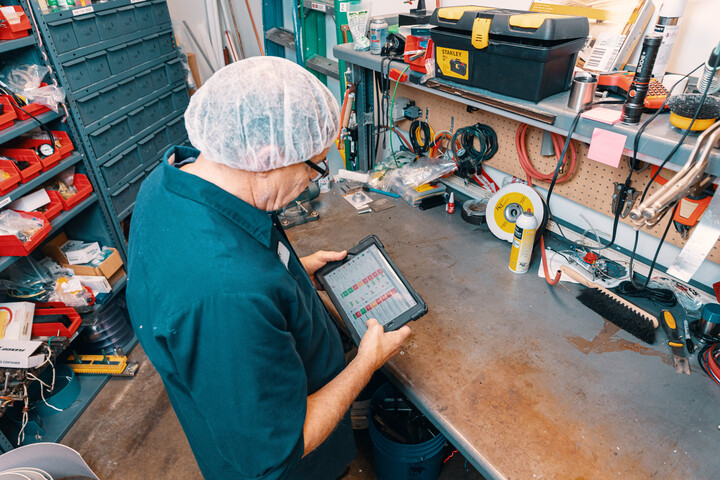
First, stabilize the affected equipment and preserve evidence before conditions change. Redzone lets your frontline teams record observations in real time, from identification to repair.
Follow your site’s approved isolation and safety procedures before inspection. Record the alarm, operating mode, product details, speed, load, environmental conditions, recent maintenance, and events immediately preceding the stop. Add photographs or video when visible evidence could change during recovery.
Don’t clear an alarm or replace a component before you document its condition, unless safety requires immediate action. Otherwise, you could lose the best evidence of the failure mechanism, which is the thing that produced the problem. Ask your operators what they saw or heard, because their observations add context that an alarm record cannot.
Step 2: Define the Failure Before Diagnosis
Your failure statement should describe what stopped working, where the event occurred, and the operating conditions at that time. “Conveyor failed” isn’t precise enough for diagnosis.
A stronger statement would be, “The discharge conveyor motor tripped twice while carrying Product B at the scheduled production rate after 40 minutes.” That description narrows the investigation without assuming a cause.
Compare the event with work history, alarm records, inspection findings, and previous corrective actions. If the same symptom returns, don’t assume the last replaced component failed again. Check common contributors such as alignment, lubrication, and electrical load, then evaluate contamination, operating practices, installation quality, or wider system conditions.
Step 3: Identify the Failure Mechanism and System Causes
Your investigation should confirm the failure mechanism and the system conditions that supported it. Methods such as Lean manufacturing, total productive maintenance (TPM), and root cause analysis help frontline teams find underlying causes and prevent recurring failures.
Use a fishbone (Ishikawa) diagram to sort possible causes into categories such as people, methods, materials, measurement, machines, and environment. It maps possibilities without ranking them, so test each one against your evidence. A Pareto chart can then help your team decide which recurring failure to investigate first.
Keep the review focused on the system rather than individuals. For example, a missed inspection could reflect unclear standards, inaccessible instructions, incomplete training, or not enough time. These systemic findings give your team a stronger basis for corrective action and support frontline ownership.
Step 4: Plan Corrective Maintenance With Acceptance Criteria
Once the cause is confirmed, plan the repair around it. Your corrective maintenance plan should fix the confirmed cause or conditions that produced the failure. Shared production and maintenance information gives your team useful context when planning the work.
Define acceptance criteria before you begin. Criteria might cover vibration limits, temperature range, pressure stability, target speed, output quality, or alarm status, along with a minimum test duration when appropriate. “The machine runs” isn’t a measurable criterion.
Document who owns the repair, identify the parts you need, and specify the test conditions and expected operating parameters. Name the person authorized to verify completion.
If evidence for a permanent correction isn’t available, classify the action as temporary and schedule another investigation. Clear labels keep people from recording short-term recovery as a completed repair.
{{callout2}}
Step 5: Complete Maintenance Repair Verification
You complete maintenance repair verification by confirming that the work corrected the stated failure under representative operating conditions.
Begin with a controlled functional check before you test the asset under its expected production load. A no-load test may confirm movement, but it cannot reveal every problem, because overheating or slipping might emerge only during production.
When practical, match the original event’s product and speed while using a comparable load and a suitable test duration. This approach provides stronger evidence than a brief restart.
Compare measured results with the acceptance criteria you defined before the repair, and record actual values instead of writing “checked” or “good.” If the equipment doesn’t meet the criteria, reopen the diagnosis. Don’t change the record to make an incomplete repair appear acceptable.
Step 6: Document Results and Monitor Follow-Up
Complete the process by documenting objective evidence and monitoring performance after production resumes. Assign an owner for each follow-up action so that the work stays visible when shifts change.
Your records should identify the original symptom and confirmed failure mechanism, along with completed work, replaced parts, test conditions, measured results, and the verifier’s name. Choose a follow-up interval based on the asset’s operating pattern and failure risk. Then review the same indicators you used for verification, and compare them with your acceptance criteria.
An immediate test may pass even when the repair won’t hold during operation. If the symptom returns, link that event to the earlier record so that the investigation can pick up where you left off.
Why Choose Redzone for Corrective Maintenance?
Redzone is a connected workforce solution that links maintenance, production, quality, and training teams. The Reliability module helps frontline teams identify equipment issues, coordinate corrective maintenance, and verify repairs using shared operating data.
Built on TPM principles, Redzone combines computerized maintenance management system (CMMS) capabilities with real-time alerts, video-based work orders, action tracking, and AI-supported insights. Redzone coaches help operators and maintenance teams build the habits needed to identify problems early, collaborate effectively, and sustain improvements.
ChampionAI uses plant data to identify risks, recommend responses, and support approved workflows. Your frontline teams stay involved in every decision.
Mobile-first access supports iOS, Android, and browsers. Redzone also integrates with existing enterprise resource planning (ERP), manufacturing execution system (MES), and other factory systems. Redzone supports more than 2,000 factories and more than 600,000 users across 39 countries.

Frequently Asked Questions
When should I close a maintenance work order?
Close the work order once the asset meets the defined acceptance criteria, and your team has documented the verification results. Follow your plant’s closure procedures, and don’t rely on a successful restart alone as proof of repair.
How long should I monitor equipment after a repair?
Set the monitoring interval according to operating cycles and failure risk. Review the asset after a representative production period, not only after a brief no-load test.
What should I do if the same machine problem returns?
Reopen the investigation and connect the new event to previous work history. Compare the symptoms with the test conditions, then review replaced parts and unresolved contributing factors before you repeat the repair.
How do I tell a temporary fix from a permanent repair?
A permanent repair removes the confirmed cause and meets the acceptance criteria you set before the work, including follow-up data. A temporary fix restores operations without that evidence. Label it as temporary, record what remains unproven, and schedule another investigation.
Can AI verify my maintenance repair without a technician?
No. AI can surface patterns and recommend actions using plant-specific context. Qualified personnel still need to evaluate the evidence, apply site standards, and accept the completed repair.