How To Build a Maintenance Team in Manufacturing



published
October 29, 2026
Key Takeaways
A maintenance team plans, executes, and documents the work that keeps production equipment safe and available.
Build the team around your assets: assess criticality first, then define roles, structure, and headcount.
The skilled-trades pipeline is tight, so plan to develop technicians, not just hire them.
Standard work, safety procedures, and a computerized maintenance management system (CMMS) give the team consistency and data.
Operators who report and address early warning signs extend the maintenance team's reach.
What Is a Maintenance Team?
A maintenance team is the group of people responsible for inspecting, servicing, and repairing a plant's equipment so that it runs safely, reliably, and at the rate production needs. Preventing unplanned downtime is a growing part of that job.
In Augury and IndustryWeek’s State of Production Health 2026, 40% of 501 manufacturing leaders named unplanned downtime a top operational challenge, up from 32% a year earlier. Only workforce constraints ranked higher, at 43%. The forecast moved the same direction. When leaders named the single factor most likely to limit production over the next 18 months, unplanned downtime drew 16%, up from 9%.
Maintenance technicians get noticed when a machine goes down, but the everyday routines that keep machines running are where they save the most money. A study from the National Institute of Standards and Technology (NIST) put the 2016 cost of preventable maintenance problems at $119 billion for US discrete manufacturers. The same study found that plants relying most heavily on reactive maintenance were associated with 3.3 times more downtime, 16 times more defects, and 2.4 times more lost sales from delays than plants relying on it least..
Avoiding those costs starts with an effective maintenance team. The ongoing skilled labor shortage makes that harder, but many plants are bridging the gap by involving operators in machine care with total productive maintenance (TPM).
{{callout1}}
What Do Maintenance Teams Do?
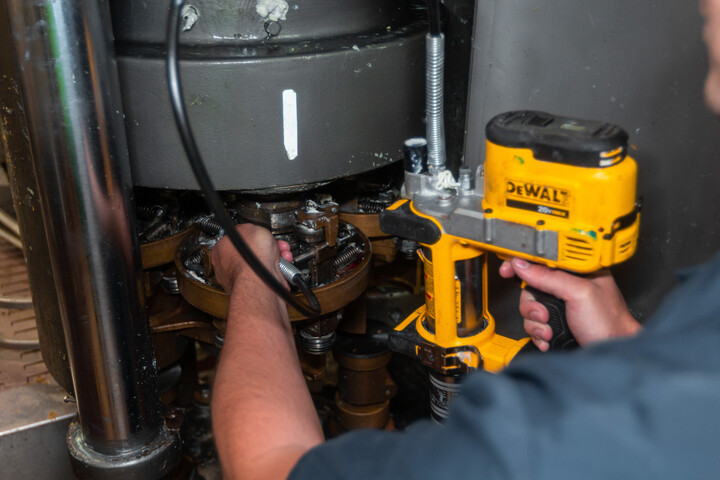
Maintenance teams do much more than fix machine malfunctions. Their major responsibilities include:
- Documentation: Maintaining equipment history, standard operating procedures (SOPs), and failure records for internal planning and auditor requirements.
- Failure diagnosis and repair: Restoring malfunctioning equipment and finding root causes of failures.
- Parts and inventory management: Keeping enough spare parts on hand without overstocking.
- Planned maintenance: Running preventive maintenance (PM) schedules and condition-based or predictive maintenance (PdM) tasks without disrupting the line's production plan.
- Safety and compliance: Following and enforcing lockout/tagout (LOTO) and other safety procedures to prevent injuries during machine failures and repairs.
- Training: Teaching operators basic equipment care, how to spot problems, and when and how to submit a work order.
- Work order execution: Prioritizing, completing, and closing maintenance work orders.
Planned work prevents equipment failures, but even plants running overall equipment effectiveness (OEE) at the world-class 85% benchmark still have outages.. When a critical machine goes down, maintenance drops everything to get the line running as quickly and safely as possible. Balancing planned and reactive maintenance requires strong leadership, scheduling discipline, and technical skills matched to your plant's machinery and highest risks.
How To Build a Manufacturing Maintenance Team
Whether you're staffing a new site or rebuilding an existing team, these six steps can help you match the team to your plant's needs.
1. Assess Your Assets and Set Goals
Before writing the first job description, determine what equipment the maintenance team will be responsible for. Gather the following information, as it will drive your staffing decisions and how you will measure their success.
- Inventory and rank the plant's equipment: First, document every asset in the plant using an equipment maintenance log, so you know what machines you have and how they must be maintained. Then rank each asset based on its risk to safety, quality, and output if it fails.
- Measure baselines: Record where the plant stands now on downtime, PM completion, maintenance backlog, and cost. Those numbers let you measure the impact of changes and spot opportunities for improvement..
- Set goals tied to production outcomes: Establish measurable key performance indicators (KPIs) based on the goals that matter most to your company. Make them "SMART": specific, measurable, achievable, relevant, and time-bound, such as "reduce unplanned downtime on bottleneck assets by 15% within 90 days."
2. Define Roles and Team Structure
The data you collected in step 1 determines the specific skills you need. Most maintenance teams include these roles:
Smaller plants may combine roles, such as a maintenance manager who sets the schedule. Decide which team structure works best for your plant: a centralized pool of technicians who work across the plant, area-based technicians assigned to lines or specific machine types, or a hybrid model.
3. Hire for Skills and Plan for Growth
Skilled trades are in high demand. The Bureau of Labor Statistics (BLS) projects 14% job growth among industrial machinery mechanics, machinery maintenance workers, and millwrights from 2025 to 2035, with about 51,900 openings a year.
You may not find candidates with experience on the equipment you run. Hire instead for core electrical or mechanical troubleshooting, comfort using a CMMS, and transferable experience from similar machinery. You can partner with technical schools to recruit new graduates, pair newer technicians with veterans to upskill them, and use a learning management system to verify that team members are qualified to work on your equipment.
4. Standardize Work and Safety Procedures
Document SOPs for preventive maintenance and common repairs, so everyone follows the same quality and safety processes no matter who's on shift. Prioritize safety and compliance-related SOPs, such as LOTO, hazard controls, and regulatory checkpoints.
Documentation protects quality, safety, and output, and keeps technicians' expertise in the plant as people retire or move on.
5. Give the Team the Right Tools
A maintenance team depends on its software as much as its hand tools. Most need four things:
- CMMS software: Work orders, PM scheduling, asset history, and parts inventory live in one digital system the whole team can reach..
- Condition monitoring sensors: Vibration, temperature, and current readings shift before a part fails, which gives teams time to intervene..
- Mobile access: Technicians and operators submit, see, and close work orders at the machine in real time, speeding maintenance response and improving data quality.
- Shared dashboards: Maintenance and production see the same downtime and PM data, so both sides plan against one set of numbers..
6. Measure Performance
Evaluate maintenance performance against the equipment reliability, availability, and manufacturing excellence goals that matter most to your plant. Common metrics include:
- Equipment failure rate
- Maintenance backlog
- Mean time between failures (MTBF)
- Mean time to repair (MTTR)
- PM compliance
How Can Frontline Operators Support Maintenance Teams?
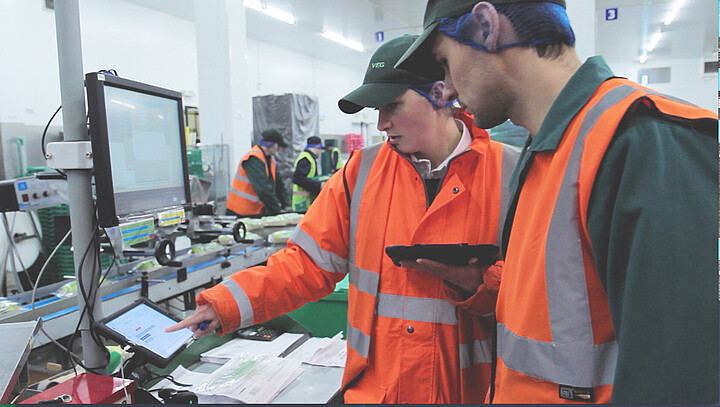
Frontline operators are the first alert system for equipment malfunctions. They notice when a machine sounds, smells, or runs differently, and they can often clear minor repeat issues such as a blocked conveyor. When they can't fix it themselves, they can alert maintenance right away.
Operators also prevent problems from starting. Autonomous maintenance (AM) is a core pillar of TPM, itself a foundation of Lean manufacturing. AM shifts standard equipment care tasks and minor repairs to operators to help keep machines running optimally.
Running AM inside a connected workforce platform does three things:
- Operators become an early warning system: They submit maintenance requests from the line with photos, video, and OEE data attached, and each request routes straight to a technician.
- Technicians spend more time on skilled work: When operators handle routine maintenance, technicians can focus on the diagnostics and repairs that need their expertise.
- Leaders see the full cost of maintenance: Managers can see the production lost to each breakdown next to the labor and parts it consumed.
{{callout2}}
How Redzone Reliability Supports Maintenance Teams
A maintenance team prevents breakdowns when it spots problems early, plans work around production, and knows what each failure costs. Redzone Reliability is the CMMS inside Redzone’s Connected Workforce Solution, built on TPM principles, and it puts technicians and the operators who run the equipment on one system.
Factories that completed a 90-day Redzone Reliability deployment averaged an additional 4.8-point OEE uplift, a 7.9% productivity improvement, and a 24% reduction in unplanned downtime. After implementing Redzone:
- Operators create, assign, and close work orders in Redzone from any device, with asset history and parts inventory in the same system.
- Managers build PM programs by asset, frequency, and production schedule, and Redzone tracks PM compliance automatically. Low-stock alerts flag critical spares before they run out.
- Supervisors can initiate guided checks by shift change, equipment run time, or calendar interval.
- Managers can track MTBF, MTTR, PM compliance, and maintenance cost in a unified dashboard for budget planning and reporting.
- ChampionAI flags adverse equipment trends and recommends next actions, leaving your team to decide where to focus their efforts.
Crest Foods spent nearly five years building a TPM program that reached fewer than four work centers. Once operators began completing digital operator care checks in Redzone, the company expanded the program to 30 work centers in three months.
Why Redzone for Building a Maintenance Team
Most plants can’t hire their way to a full maintenance team right now, so the practical move is extending what the technicians you already have can cover. Redzone’s Connected Workforce Solution does that by pulling operators into daily equipment care and routing what they find straight to a technician. Redzone coaches with frontline experience work with your team through the first 90 days, which is often the difference between a TPM program that spreads across the plant and one that stalls at a few work centers.
To see how Redzone connects your operators and maintenance team, book a demo.

Frequently Asked Questions
What roles should be on a manufacturing maintenance team?
Most manufacturing maintenance teams include a maintenance manager, planner or scheduler, supervisors, and mechanical, electrical, or multicraft technicians. Larger plants often add reliability engineers. Smaller plants often combine roles.
How many maintenance technicians do I need for my facility?
There's no universal staffing ratio; headcount depends on asset count and criticality, shift coverage, and how much work is reactive versus planned. Start from your asset inventory and planned work hours, then adjust for contracted specialty work.
What skills should a maintenance manager hire for?
Hire for mechanical and electrical troubleshooting, safe work practices, comfort with a CMMS and mobile tools, and clear communication. Candidates willing to learn may be as valuable as experienced ones, given current shortages of skilled trades.
How do operators help with maintenance?
Operators support maintenance through autonomous maintenance: routine cleaning, inspection, and lubrication (CIL) checks, plus early reporting of abnormal sounds, vibrations, or smells. This catches problems sooner and frees technicians for skilled repairs.
What is the difference between a maintenance team and a reliability team?
A maintenance team keeps equipment running day to day through inspections, PMs, and repairs. A reliability team works further upstream, analyzing failure history to change designs, intervals, and strategies so the same failures stop recurring. Smaller plants combine both jobs in one group.